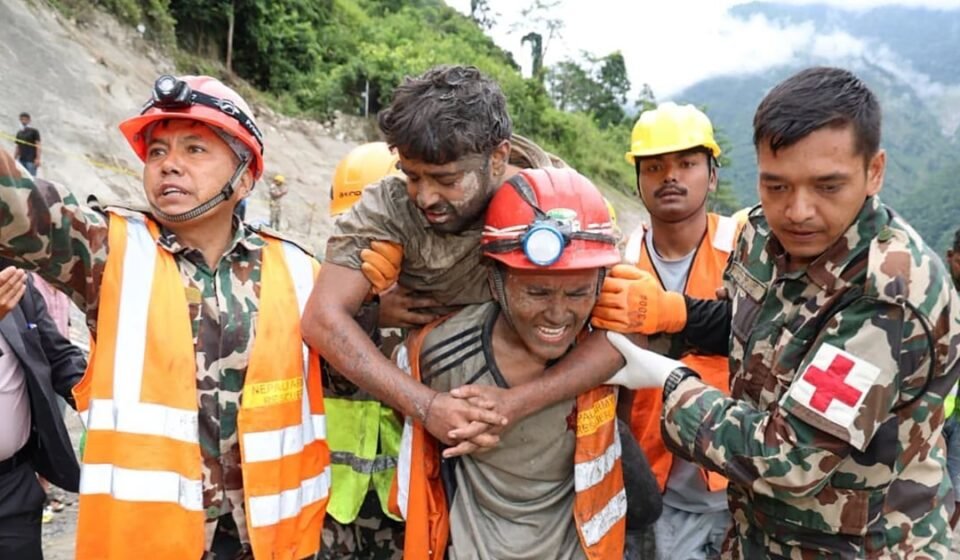

In a rare moment of hope amid widespread devastation, two workers were pulled alive from a hydropower tunnel in Nepal on Friday, roughly nine days after catastrophic floods swept through the Himalayan region, leaving thousands dead or missing.
The rescued men, identified as Sanjay Sah, a 30-year-old mechanical foreman, and Kabir Maharjan, a 45-year-old mechanical supervisor, were brought out by emergency teams, according to Nepal’s army and the National Disaster Risk Reduction & Management Authority. Both were flown to a hospital in Kathmandu for treatment.
Rescue at Trishuli 3A Hydropower Plant
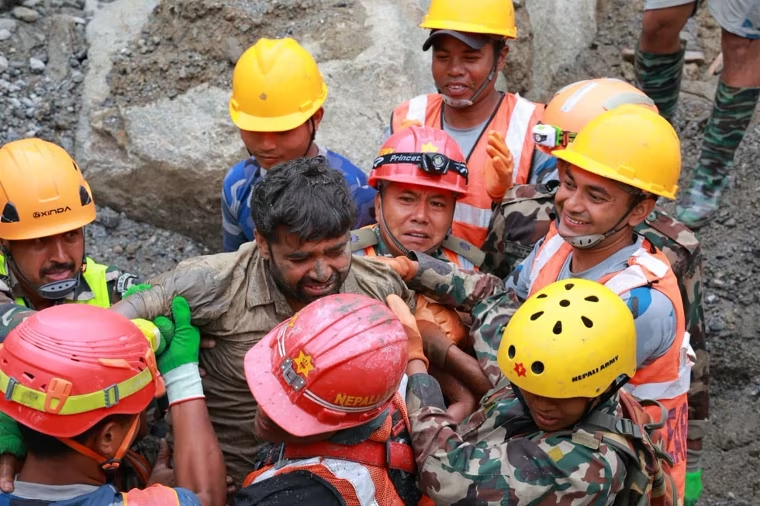
The dramatic rescue took place at the Trishuli 3A hydropower plant along the Trishuli River in Rasuwa district, near Nepal’s border with China. Rescue officials reported hearing voices of other workers still inside the tunnel, raising hopes that more survivors may be found.
At least 557 workers are still believed to be missing at the site, with around 115 thought to be trapped in the main tunnel, according to the Independent Power Producers Association of Nepal.
Army Releases Images of Rescue
Nepal’s army shared images of the operation on its official Facebook page, including one showing the first rescued worker, covered in mud, being carried from the site on a rescuer’s shoulder. The caption read: “When hope is alive, even the impossible becomes possible.”
Amir Maharjan, brother of one of the rescued workers, told The Associated Press, “I can’t explain what we are feeling at the moment. We are just grateful to God.” He added that the family was on its way to the hospital to see him.
Ongoing Efforts to Reach Trapped Workers
Army spokesperson Brig. Gen. Raja Ram Basnet said one of the survivors told rescuers that more people were still alive inside the tunnel. Nepal’s communication minister, Bikram Timilsina, wrote on Facebook, “We are waiting for the rescue of more and more people.”
More than 900 workers are missing from about a dozen hydropower projects in Nepal, with roughly 500 believed to be trapped in tunnels, according to local officials. Rescue teams have faced significant challenges accessing these sites, many of which are in remote, mountainous areas. Bad weather, damaged roads, and collapsed tunnel sections filled with mud and debris have hampered efforts.
Aided by foreign experts, rescue teams have been working around the clock, using controlled blasts, excavators, and earth-moving equipment to reach the trapped workers. Concerns remain about air quality inside the tunnels and whether workers have access to drinking water.
Broader Disaster and Casualties
Authorities in Nepal report at least 1,287 people killed and more than 5,000 still missing after the August 26 disaster, believed to have been triggered by a high-altitude glacier collapse on the Nepal-China border. In China, a mudslide hit a major land crossing between the two countries, with the only road to the site in Tibet’s Gyirong county fully reopening only on Wednesday. Chinese officials say at least 21 people were killed and 541 are missing on the Tibet side of the border.
More than 800 foreign nationals are among those missing in the area, which is popular with trekkers and pilgrims. According to the State Department, 75 Americans remained unaccounted for as of Wednesday, while 16 had made their way to safety.