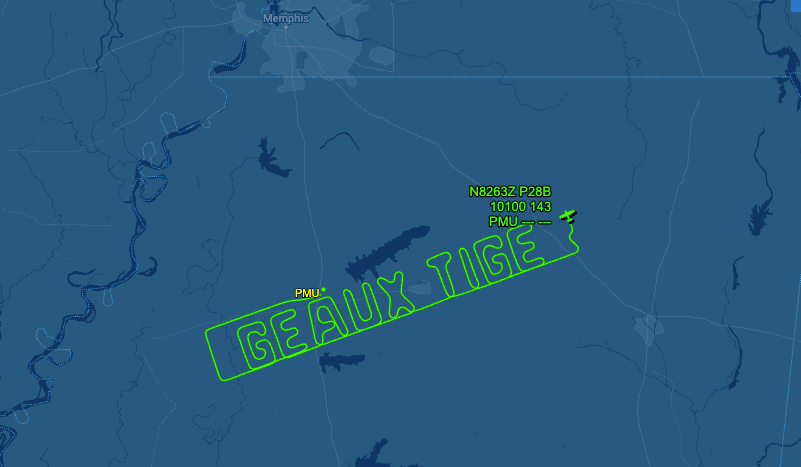

OXFORD, Miss. — A pair of pilots turned the airspace above Oxford into an unlikely canvas this September, tracing messages on their flight paths that were never meant to be read in the sky. Instead, the words appeared only on flight-tracking websites, where anyone following along could watch the letters take shape in real time.
The first message came from Joshua Gregory, a pilot from Oxford. His flight path spelled out “Lane Closure Ahead,” a phrase that Oxford Eagle readers would recognize as a reference to Lane Kiffin, the former Ole Miss head football coach. The words were not visible to anyone looking up from the ground. They existed solely as a digital trail on flight-tracking software, where the aircraft’s route formed the letters.
A Digital Skywriting Act

Unlike traditional skywriting, where a plane releases smoke to write in the air, these messages relied entirely on the aircraft’s recorded path. Gregory and the second pilot, Matthew Becker, are not skywriters. They are pilots who mapped their routes in advance to create specific shapes, according to information published by The Oxford Eagle. The result is a kind of message that lives on screens rather than in the clouds.
Two days after Gregory’s flight, Becker took to the same airspace with a message of his own. Becker, an LSU fan, spelled “GEAUX TIGERS” with his flight path. The phrase is a familiar rallying cry for supporters of the Louisiana State University Tigers, and it served as a direct response to Gregory’s earlier message. Becker’s flight occurred on September 17, 2026, and is viewable on FlightAware under the flight number N8263Z.
The exchange highlights a growing trend among aviation enthusiasts who use flight-tracking technology to create temporary, digital messages. Because the letters appear only on tracking platforms, the audience is limited to those who know to look. In Oxford, residents and others followed the flights online, watching the paths unfold on their screens.
How Flight Path Messages Work
Creating a message with a flight path requires careful planning. Pilots must chart a course that, when viewed from above on a tracking map, forms the desired letters. The aircraft’s GPS coordinates are recorded and transmitted to services like FlightAware, which then display the route as a continuous line. By flying in specific patterns, a pilot can draw words or shapes that are visible only to users of those services.
The technique is distinct from skywriting in several ways. Skywriting is visible to anyone looking up, but it depends on weather conditions and dissipates quickly. Flight path messages, by contrast, are permanent digital records that can be viewed long after the flight has landed. They also require no special equipment beyond the aircraft’s standard tracking systems.
Gregory’s message, “Lane Closure Ahead,” played on the name of Lane Kiffin, who previously coached Ole Miss. The phrase suggested a kind of closure or end for Kiffin, though the brief does not specify the exact intent behind the wording. What is clear is that the message was designed to be seen on flight trackers, not in the sky.
Becker’s response, “GEAUX TIGERS,” is a well-known cheer among LSU fans. By spelling it out over Oxford, Becker added a layer of rivalry to the digital exchange. The two flights were separated by two days, with Gregory’s occurring first and Becker’s following on September 17, 2026.
Viewing the Flights
For those interested in seeing the messages for themselves, Becker’s flight can be found on FlightAware using the flight number N8263Z. The tracking data shows the path that spelled “GEAUX TIGERS.” Gregory’s flight, which spelled “Lane Closure Ahead,” is also a matter of public record on flight-tracking platforms, though the brief does not specify a flight number for his aircraft.
The Oxford Eagle published an article about the flights, written by Alyssa Schnugg, which detailed the messages and the pilots behind them. The article states that Gregory’s message referenced Lane Kiffin and that Becker’s message was a response from an LSU fan.
While the messages were not visible to the naked eye, they were clearly visible to anyone watching flight trackers. In Oxford, residents and others followed the flights online, turning a pair of routine flights into a shared digital event. The pilots’ efforts demonstrate how technology can transform a simple flight into a form of communication that transcends the physical sky.
As flight-tracking apps become more popular, it is likely that more pilots will experiment with spelling messages in their flight paths. For now, the Oxford flights stand as a creative example of how two pilots used their aircraft and a tracking website to carry on a friendly rivalry — one letter at a time.


