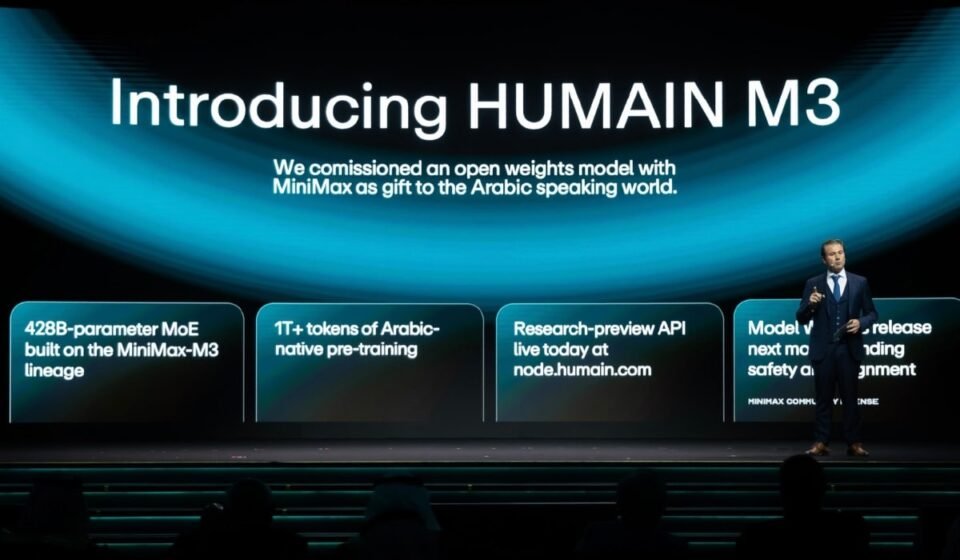

Saudi Arabia’s artificial intelligence company HUMAIN, a subsidiary of the Public Investment Fund (PIF), has announced the launch of “humain-m3,” an advanced Arabic language model developed by China’s MiniMax at the request of its Saudi partner. The announcement was made during the LEAP 2026 technology conference in Riyadh, underscoring the kingdom’s push to strengthen Arabic’s presence in cutting-edge AI technologies and foster a more sophisticated Arabic AI ecosystem.
Research Preview on HUMAIN Node

HUMAIN stated that the model is now available in a research preview phase through its “HUMAIN Node” platform. This platform offers developers, researchers, and enterprises access to advanced AI models and reasoning capabilities, allowing them to test the model, evaluate its potential, and provide feedback before the planned open-weight release.
Technical Foundation and Training
humain-m3 is built on the MiniMax-M3 series of models, utilizing a Mixture-of-Experts (MoE) architecture with 428 billion parameters. The model underwent additional pre-training on over one trillion tokens of original Arabic content, aimed at enhancing its abilities in Arabic language understanding, reasoning, and handling of Arabic content.
Performance in Arabic Benchmarks
According to the company’s evaluations across seven general Arabic benchmark tests, humain-m3 achieved the highest average performance among advanced AI models assessed, recording strong results in Arabic language understanding and reasoning.
Strategic Importance for Arabic AI
The launch is part of HUMAIN’s broader strategy to develop advanced AI capabilities tailored to the Arabic language, while simultaneously expanding access to these technologies for developers, researchers, and institutions. The HUMAIN Node platform enables users to build, test, and deploy AI applications, and connects organizations with advanced models from HUMAIN and other global AI companies.
Tariq Amin, CEO of HUMAIN, emphasized that although Arabic is spoken by hundreds of millions of people, it remains underrepresented at the forefront of AI technologies. He affirmed that the company is investing to change this reality. Amin added that making humain-m3 available via HUMAIN Node will give developers, researchers, and innovators the opportunity to experience the model’s capabilities, build upon them, and develop the next generation of Arabic-language AI applications and experiences.
Aligning with Saudi Arabia's AI Ambitions
This move is part of a wider national effort by Saudi Arabia to boost its AI capabilities and build a competitive domestic ecosystem. HUMAIN is investing in data centers, chips, and the infrastructure necessary to develop and operate AI technologies at scale.
The initiative also reflects a growing global trend toward “sovereign AI,” as competition intensifies between American and Chinese companies in developing advanced AI models. Many countries are seeking to strengthen their local capabilities to ensure their economies and workforces benefit from AI-driven transformations.
Complementary Developments and Future Plans
In parallel with humain-m3, HUMAIN continues to develop its own models and products, including the “ALLAM” family of Arabic language models. The company also invests in and collaborates with leading global AI firms to broaden access to advanced capabilities.
HUMAIN plans to release humain-m3’s weights openly under the MiniMax Community License after completing safety and alignment training phases, with a target launch within the next month. This open release is expected to expand the model’s use among developers and researchers.