

EarFun has built a reputation for packing ambitious features into budget-friendly products, and the Wave Pro X over-ear ANC headphones continue that pattern. Priced at $130, the headphones are available through EarFun’s official global store and Amazon, with a 20% discount available using coupon code EFWPXNBC. A white variant is not yet listed, but EarFun says it will launch later, paired with a grey and white case instead of the black case that ships with the black model.
In his review for Notebookcheck, Vineet Washington examined whether the Wave Pro X can justify its feature list in everyday use. The short answer: after tuning, the sound holds up well, comfort is excellent, and battery life, while below EarFun’s claims, remains generous.
A dual-driver design that stands out
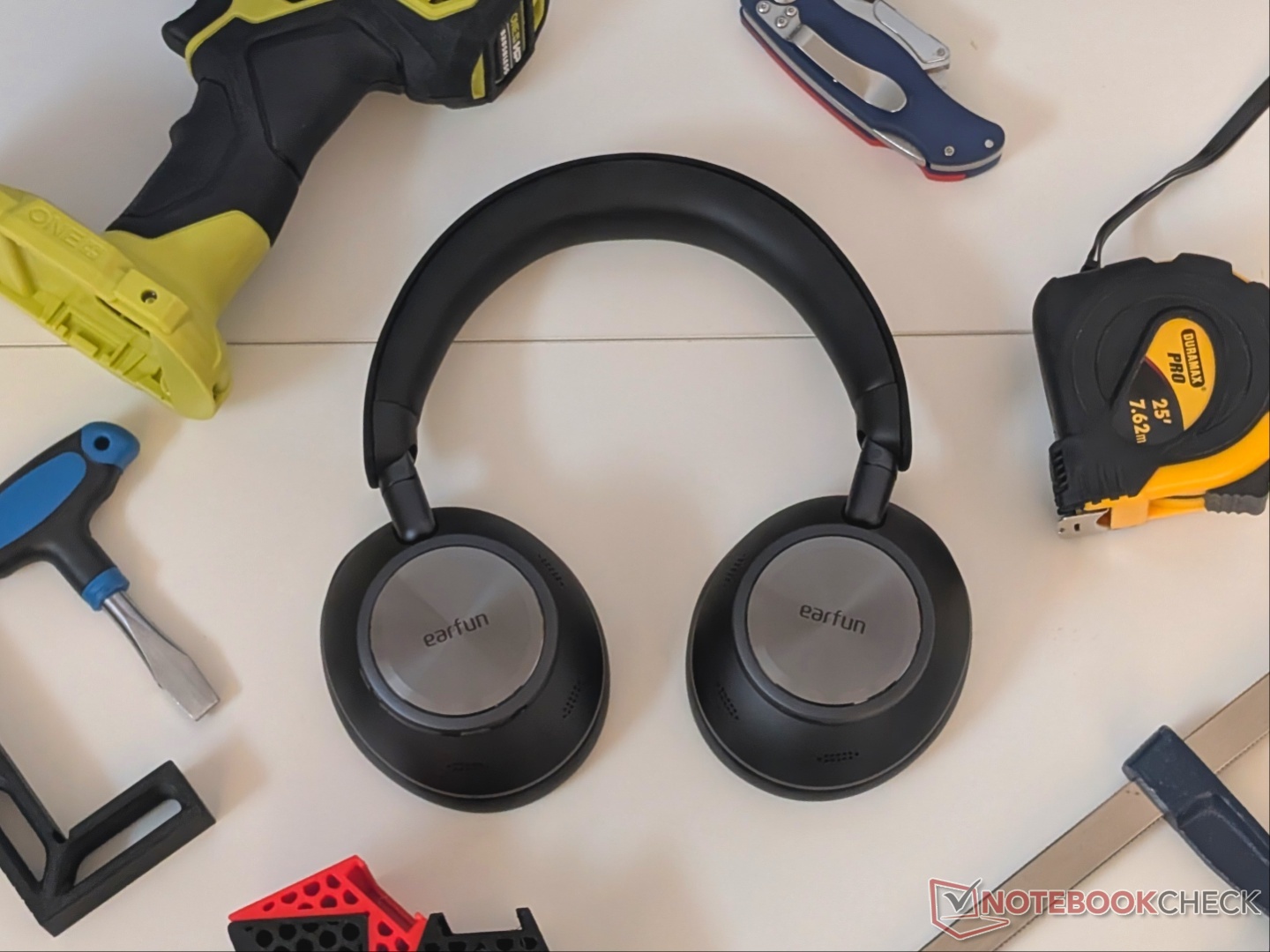
The Wave Pro X uses a dual-coaxial acoustic architecture with a 40mm dynamic driver and a 10mm dynamic driver working together. According to EarFun, this is the first time a dual-coaxial setup has been combined with ANC in headphones, and the first time DLC and LCP drivers have been paired in this way. Dual drivers are uncommon in headphones, and the frequency response spans 20 Hz to 20,000 Hz.
Qualcomm’s QCC3095 chip powers the headphones, enabling a long list of codecs: LDAC, SBC, AAC, aptX Adaptive, aptX Lossless, and LC3. The Wave Pro X also carries Hi-Res Wireless certification and supports Bluetooth LE, Auracast, and Google Fast Pair. Bluetooth 6.0 is on board, and a 3.5mm cable connection is available for wired listening.
Comfort and controls
At 259 grams, the headphones use memory foam padding on both the earcups and the headband. The earcups offer 12 levels of size adjustment and can swivel flat and fold. The hard-shell carrying case accommodates the earcups when flat, not folded, and includes a slot for cables. A USB-A to USB-C cable and a 3.5mm audio cable are included, though the reviewer found the USB cable short and recommends a longer third-party option for charging while listening.
The reviewer wears glasses and reported no discomfort even over long sessions. The earcups are deep enough that ears do not touch the mesh, and the clamping force is suitable for glasses wearers. Controls sit on the right earcup, where four multifunctional buttons can be customized. The buttons are clicky and easy to reach.
ANC, codecs, and connectivity
The Wave Pro X uses Adaptive Hybrid ANC with eight microphones. Two AI-powered modes are available: AI Ear Adaptive ANC and AI Environment Adaptive ANC. EarFun claims the AI delivers millisecond adjustments. The reviewer found AI Ear Adaptive locked at maximum, while AI Environment Adaptive proved more reactive to surroundings. Wind Noise Cancelling works independently, but it cannot be combined with the AI modes. A transparency mode is also included.
Codec support affects dual-device connection. LDAC disables dual-device connection, while aptX Adaptive and aptX Lossless keep it active. The reviewer tested LDAC at 990kbps on a Pixel 9 Pro XL and found it stable, noting that Pixel updates may have fixed earlier stability issues.
Auracast is supported, though the reviewer notes that the feature needs larger brand support before it becomes mainstream. The same applies to Bluetooth LE audio more broadly. Google Fast Pair simplifies pairing with Android devices.
App features and sound quality
The EarFun Audio app handles customization. It includes a detailed EQ menu with simple and professional modes, plus a My Sound Profile option that tunes the EQ to the user’s ears. Hearing Health settings limit volume and balance channels. An auto shutdown timer can be set, but the minimum of 30 minutes was deemed too long. The app also offers AI Translation with Face-to-Face and Real-Time modes, using the onboard microphones to send translated speech to the listener’s ears. Third-party apps can do the same, but the integrated approach is convenient.
Out of the box, the reviewer found the default EQ sounded closed off and muffled. Switching to the Rock or Hip Hop presets made the sound more open. Bass is punchy and crisp without distortion at maximum volume. The reviewer typically listened at 30–40% volume and occasionally at 50–60%.
USB Audio allows charging while transmitting audio, which is useful for wired listening sessions. The reviewer did not report any latency issues with the codecs tested.
Battery life and charging
EarFun claims 90 hours of playback with ANC off and 50 hours with ANC on, from an 800 mAh battery. Fast charging is said to provide 10 hours of playback from a 15-minute charge. The reviewer described these claims as enthusiastic, as the headphones lasted 8–9 days with 4–5 hours of daily ANC use. Even so, the actual battery life remains plenty for most users.
Comparison with Baseus Inspire XH1
The Baseus Inspire XH1 is a pricier competitor, and the reviewer found it sounds marginally better and has better ANC. However, the Baseus model lacks aptX codecs. The Bose tuning partnership on the Baseus is noted in the brief, but the reviewer’s conclusion is that the Wave Pro X offers better value overall.
Verdict
The EarFun Wave Pro X delivers strong value for $130. Its dual-driver setup, extensive codec support, and long battery life make it a compelling option in the budget ANC headphone market. Comfort is excellent, even for glasses wearers, and the app provides deep customization. The default EQ requires adjustment, and the ANC is average but sufficient for most environments. The white variant is expected later, and the 20% discount with code EFWPXNBC makes the price even more attractive.
Pros:
- Dual-coaxial 40mm + 10mm drivers
- LDAC, aptX Lossless, aptX Adaptive, AAC, SBC, LC3
- Comfortable for glasses wearers
- Long battery life
- Extensive app features
- Auracast and Bluetooth LE support
- Physical controls
Cons:
- Default EQ sounds muffled
- ANC is average
- Battery life below claims
- Included USB cable is short
- Auto shutdown minimum 30 minutes
- Wind Noise Cancelling cannot combine with AI modes
The review sample was provided free by the manufacturer. No third-party influence affected the review, and the manufacturer did not receive a copy before publication. There was no obligation to publish.


