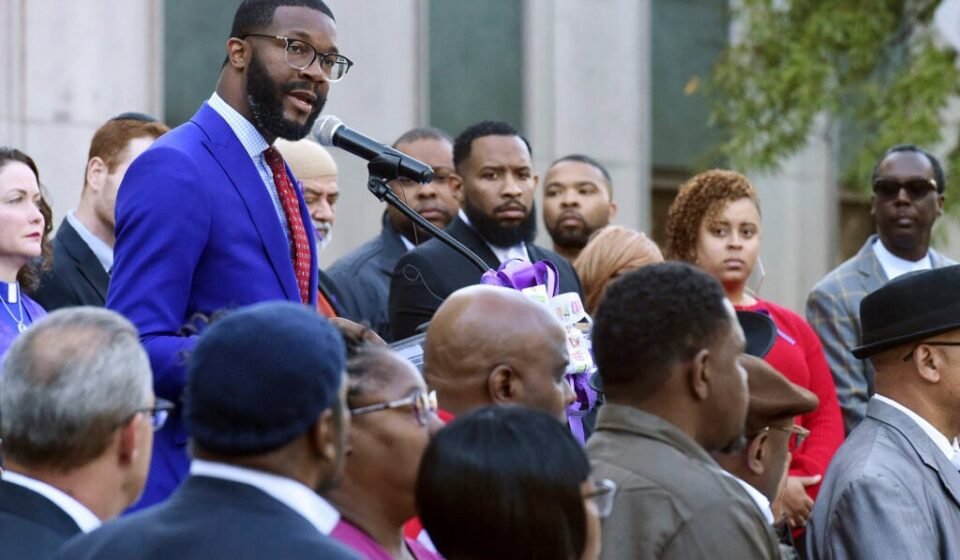

Just two years ago, as much of the nation saw historic drops in crime, Birmingham was enduring its deadliest year since the 1930s. The Alabama city recorded 153 murders in 12 months, a homicide rate roughly double that of Detroit or Chicago and nearly triple Philadelphia’s. But now, Mayor Randall Woodfin sees a turning point. Last year, homicides fell below 100 for the first time in a decade, and in the first half of this year, the city recorded just 24 homicides—a 70 percent drop from the same period in 2024, when there had been 80 by mid-year.
Woodfin, who lost his brother, nephew, and brother-in-law to gun violence, spoke with The Trace about the strategies behind the decline, from police staffing and high clearance rates to school-based conflict mediation and hospital-linked intervention. The conversation has been edited for length and clarity.
What’s Behind Birmingham’s Dramatic Drop in Homicides?

When crime peaked in 2024—at levels not seen since at least 1933—Woodfin says the city had no choice but to act. “We put everybody in the room,” he explains. That included corporate leaders, small-business owners, community activists, faith leaders, educators, and others. A commission formed to recommend safety improvements returned 82 proposals, and the city has acted on more than two-thirds within two years.
During that same period, the city drew $16.1 million from its reserve account for a police recruitment and retention plan. Today, Birmingham has a full police force, operating at 100 percent of its budgeted officer count. The city also hired a new police chief, Michael Pickett, whom Woodfin credits with improving morale and ensuring officers have the resources and technology they need.
Investing in Community Violence Intervention
The city partnered with its health department—which declared gun violence a public health crisis—along with the University of Alabama at Birmingham Hospital and other groups. These organizations focus on conflict resolution, dispute intervention, and de-escalation. “You can’t make communities safer just by taking guns out of people’s hands,” Woodfin says. “You also have to put a job back in their hands, and you have to make their neighborhoods cleaner and safer.”
Residents also stepped up, calling 911, joining neighborhood watch programs, and participating in Birmingham Connect, which lets homeowners feed exterior camera footage into the city’s real-time crime center. Woodfin calls this civic engagement “one of the most powerful things we did.”
Focused Deterrence and Hotspot Policing
Woodfin emphasizes that taking violent offenders off the street is paramount. “People who are hell-bent on shooting people, doing drive-bys, murdering people, and committing gun violence cannot be committing that kind of harm,” he says. The city pairs thorough investigations and arrests with saturation patrols in known hotspots, but not just for enforcement. “We also seeded resources around community development, infrastructure upgrades, supporting families, educating their children, and providing other resources,” he explains. “It was a holistic approach with wraparound services, not just police going in alone.”
Cleaning Up Blight to Reduce Violence
Woodfin believes that “a lot of behavior is based on place.” Over eight years, the city has spent $25 million in public funds to remove blight and overgrown lots. “Removing things that are not only eyesores but also give the visual impression that people or government do not care” is part of stabilization, he says. “For a city our size, that is a significant amount of public resources.”
Personal Lessons and a High Clearance Rate
Woodfin’s personal losses—his brother, nephew, and brother-in-law all killed by gun violence within the last 14 years—shape his approach. “There’s not a day that goes by that I don’t think about how it has affected my own family,” he says. He recalls “the scream my mother cried out,” a sound he has heard from other mothers too often. “I’ve never lost sight of making sure that I do everything necessary to have fewer mothers make that scream.”
The city has reached a clearance rate of more than 90 percent for homicides. “That means if you kill somebody in the city, the Birmingham Police Department is making an arrest,” Woodfin says. This sends a clear signal: “If you commit gun violence, we are coming after you, and you will be held accountable.”
From Schools to Hospitals: Expanding Intervention
Birmingham has invested in conflict resolution in schools, aiming to change how younger generations handle disputes. The school system has seen fewer infractions, suspensions, expulsions, and fights. “These are some of the same young people involved when crime spikes in the summer,” Woodfin notes.
On the adult side, a program with Offender Alumni and UAB Hospital works with gunshot victims admitted after being shot. Participants have not reoffended, been shot again, or killed someone. The program is now expanding into the emergency room. Street teams also intervene after shootings to de-escalate feuds and reach residents in ways elected officials cannot.
Sustaining Funding Beyond Federal Aid
Many cities used federal American Rescue Plan funds for violence intervention, but those funds are ending. Birmingham has shifted to local funding: $1.5 million from the general fund last year, doubled to $3 million this fiscal year. The funding has its own budget, separate from the mayor’s office and police department. “We believe we should be held to a higher standard,” Woodfin says. Organizations must show measurable results to keep or increase funding.
Federal and State Roles: A Local Approach
Woodfin credits local efforts for Birmingham’s decline, not federal intervention. “We didn’t have intervention or support in this work from anybody else,” he says. The city declined offers of National Guard deployment. “We empowered ourselves locally and took charge locally.”
On state relations, Woodfin notes successes like a state law against exhibition driving, which was linked to car thefts and stolen guns, and a law targeting Glock switches. But he criticizes the state Legislature’s removal of concealed carry permit requirements, which police opposed. “That was a struggle,” he says. Still, he partners with other Alabama mayors to get things done.
Is Birmingham’s Progress Sustainable?
Woodfin is hopeful. “The way to maintain the perception that the city is safer is to make the reality that the city is safer,” he says. “Our reality is that the city is much safer in 2026 compared with 2024.” He stresses the need for sustained resources and commitment. “Public safety works in waves,” he acknowledges, “but a sustained effort, sustained resources, sustained commitment from leadership and organizations, and people continuing to feel empowered is how we sustain both the tangible reality and the perception.”