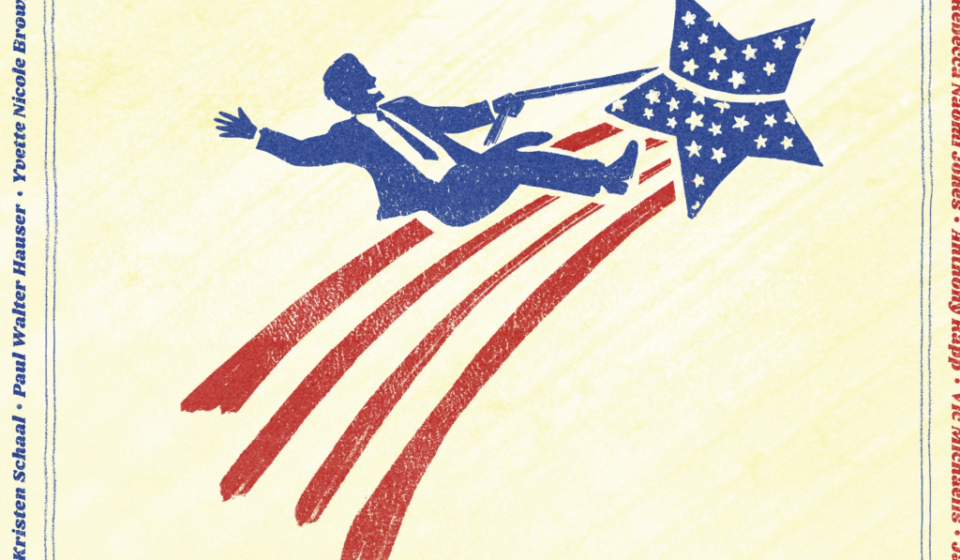

Los Angeles — A new theatrical concept album, “Good Guy with a Gun!,” uses satire, a string-dominant orchestra, and a celebrity cast to imagine the end of the Second Amendment. Created by singer-songwriter Philip Labes and his collaborators, the album is billed as “Book of Mormon for the NRA.”
A Story of a Father, a Daughter, and a Magic Gun

The album, released August 14, follows Ron, a father who becomes an NRA lobbyist after his wife dies in a mall shooting. Ron is voiced by Chris Sullivan, known for his role on the NBC series “This Is Us.” His daughter Jenna, a liberal student, is voiced by Kimiko Glenn, recognized for her work on the Netflix series “Orange Is the New Black” and the original Broadway cast of “Waitress.” God, voiced by Jason Alexander, who played George on “Seinfeld,” gives Ron a magic gun that turns people conservative and Jenna a magic megaphone that turns people liberal.
The narrative builds to a climactic number, “On the Day (The Second Amendment Is Wiped Away),” reminiscent of Les Miserables. It opens with right-wingers singing of “the day that we’ve always feared, the liberals come to take our guns away.” A brief monologue from a Cockney woman follows, spiraling into mania: “They came at night, they took the little ones first. Glocks, small handguns you keep under your pillow. It was an invasion. Basements and attics violated. Soon, they’ll come for the rest. Family heirlooms, hunting rifles, Gatling guns, historical cannons!”
The cast also includes Richard Kind, Anthony Rapp, Vic Michaelis, and Yvette Nicole Brown. The album concludes with the revelation that people have different opinions not because they’re “doo-doo and stinky,” but because they’re “trying their hardest.”
Satirizing Both Sides of the Gun Debate

“Good Guy with a Gun!” skewers the NRA’s “good guy with a gun” myth, as well as liberal inclinations like a love for Trader Joe’s or a couple crooning “our preferred pronoun is us.” Labes and his collaborators, Micah O’Konis and Hal Rosenfeld, aim to question existing conversations and seemingly intractable realities about gun politics. Labes said they are “imagining new ways to be.”
Labes, a musician and comedian with several hundred thousand followers across social media platforms, said he wanted to explore the end of the Second Amendment “to remind people that other countries routinely rewrite their constitutions. That laws are meant to be statements of values.”
Personal Connections to Gun Violence
Labes was initially drawn to the subject after a personal brush with gun violence. About a decade ago, he was held up at gunpoint. As he told a crowd at an album release party, he immediately started writing a musical about it with O’Konis, then his housemate. After that, Labes said, the duo “did a lot of deep dives into the NRA: their leadership structure, and their history within the larger context of the way conservatives create political agitprop and political theater.”
Rosenfeld, the album’s executive music producer and orchestrator, attended middle school with Labes. He also has a personal connection to the project: Rosenfeld was held at gunpoint in LA. “I’m very lucky to be alive,” Rosenfeld said. “It’s just very apparent that there’s a problem, and it’s unfortunate that people who are not mentally stable have access to guns.”
A Self-Funded, Genre-Spanning Production
The album is a self-funded project that spans multiple genres, from the Beach Boys-esque “Liberal Guilt Trip” to the gospel bop “N-R-AMEN!,” the jazz number “Do The Lobby,” the Western “Good Guy with a Gun,” and the R&B-fueled “I Like To…”
The cast came together through the creators’ connections and outreach. Glenn and Yvette Nicole Brown were following Labes on social media, Rosenfeld said; the group knew Michaelis from LA’s comedy scene; and Brown and Kind share a manager. “You would think this production had a lot of money to get Jason Alexander and all these people,” Rosenfeld said. “These actors worked for way below what probably any of their agents would let them work for. But every single one of them believed in the project, and were very vocal about that.”
Behind the Scenes: Interviews with the Creators
In separate conversations with The Trace, Labes and Rosenfeld detailed how a small team spent over a decade turning their concern about gun violence into a musical concept album. They discussed why they made the album, how writing satirically changes a story, and what they want to happen next. These conversations have been lightly edited for length and clarity.
The Origin: A Personal Encounter
Joy Resmovits asked Labes if he felt comfortable talking about the incident that started it all. Labes recounted: “In my sophomore year, I was held up (at gunpoint) on the Expo Line, traveling back to USC. There was an active shooter on our campus a month later. I also went to high school after Columbine. There was this growing sensation that it became normalized through the choices and non-choices of political actors. I was investigating that feeling: I feel uneasy and unsafe, and I don’t think it’s my fault. It’s not one person’s fault, but the NRA was a big part of it. They were a real threat to any politician who would try to do anything about it. As we sat down thinking about what would make a kind of funny musical, the first instinct was: who is the least likable person we know? And we were like, how about the president of the NRA, or a lobbyist for the NRA?”
Resmovits noted that Labes’s awareness of guns crystallized after he faced them himself, but he had moved from a state with much more permissive gun-buying and gun-carrying policies into one with much stricter laws. Labes responded: “I grew up in a pretty rural area in Florida. I remember people would drive down our street with a Confederate flag flying out of the back of their truck. I didn’t grow up in a conservative house.”
When asked what happened next after deciding to write about the least likable person, Labes said: “We drafted the story and we wrote songs. The core of the idea has always been the same: a conservative father, his liberal daughter, and a magical gun that he receives from God that gives him everything he wants.”
Hal Rosenfeld’s Involvement
Rosenfeld explained how he got involved: “I’ve known Philip for a long time, and I was aware of an earlier version of this project that he and Micah had put on like 10 years ago. And then, through Philip and I doing a lot of musical improv together at UCB (Upright Citizens Brigade), and Micah as well, Philip and Micah approached me about possibly producing it as an album.”
Musical Choices and Motifs
Resmovits asked why “Do The Lobby,” a song depicting how the NRA lobbies, was made a jazz number. Labes explained: “Do The Lobby” was always a tune we thought should be very jazzy and slick. As musical theater writers, we get to take big creative liberties, and it was important that we keep it moving through the relatively boring actual work of being an administrator and lobbyist. It’s important, if you’re going to do exposition, that you put some sauce on the medicine.”
Rosenfeld elaborated on the musical direction: “I work in film, scoring cinematic styles of music, but I also work a lot with pop artists, and jazz bands, and rock bands, and orchestral artists. I love everything. The direction Broadway has been heading feels a bit stagnant. I’ve always wanted to work on a Broadway show that has more creative freedom. I immediately heard the different influences and style opportunities. Hearing “Do The Lobby” for the first time I thought, I would absolutely eat this up for breakfast as a giant big band number, where you’re not confined to what fits in a Broadway pit. On the God stuff, you’ve got giant orchestras and choirs. And then you’ve got “Do The Lobby,” which has a 20-piece big band.”
Rosenfeld also highlighted a subtle musical quote: “The one some people have started to catch onto is in “On the Day.” When Lisa Bushmaster, the president of the NRA, has a line that goes, “Oh, here come liberals to gloat,” we quoted the opening of “Hamilton” musically. Also in “On the Day,” in one of Ron’s verses, I used a banjo in the same way that my dear friend and former collaborator, Alex Lacamoire (who orchestrated, co-produced, and music directed Hamilton), uses the banjo in “The Room Where It Happens,” working in place of rhythm guitar.”
Surprises and Insights
When asked what aspect of gun violence or gun policy surprised him the most, Labes said: “It’s hard to be shocked anymore. Part of the reason we overturn the Second Amendment is to remind people that that is possible, to remind people that other countries routinely rewrite their constitutions. That laws are meant to be statements of values. There seems to be a significant portion of our country that thinks the law is more important than the value behind the law. What I’m surprised by is that we engage with the conversation on their terms, instead of imagining new ways to be and convincing people that those ways are better.”
On the idea of a magic gun and a magic megaphone, Labes explained: “The magic in a show always has to be a metaphor, so we were like: What is the metaphor? And in this case, the metaphor is basically that it can feel like the other side is brainwashed. If you ask someone in a blue city, they’re probably thinking MAGA is a cult, they’re brainwashed. Talk to that conservative, and they’re going to say liberals are a cult and they’re brainwashed. So we wanted to play with that world, and give our lead characters — and by default, the audience — the experience of: here’s exactly what you want, everyone agrees with you. Is that better?”
Why an Album and Future Plans
Labes explained why they chose to share the work as an album: “We wanted something that was incredibly accessible. Broadway tickets are increasingly expensive. We’re open to putting it up Off Broadway, on Broadway. We’re open to bringing it to schools or developing it as a film. But all those things require partners, because this project was entirely self-financed.”
On the challenges of satire, Labes acknowledged: “You can’t honor everything in the fullness of its experience. That’s normal to any narrative. You have to use shorthand, or flatten certain experiences. And that’s always difficult — we want to honor every possible thing, but ultimately a great story is also about what you don’t talk about. So it was important to us to stay focused on the relationship between Ron and Jenna.”
Desired Impact
Labes shared his hopes for the album’s effect: “I don’t think any of us think the show is going to solve gun control, or stop the violence, unfortunately. But I hope it makes people slow down and listen to one another. I hope it reminds people that the things that unite us are stronger than the things that divide us. And I hope it helps people laugh at things that they think they can’t laugh about. When you laugh together, it’s harder to think of someone as your enemy. It’s harder to be angry at them. It’s harder to assume that they are dumb and don’t get it. And it humanizes them.”
Rosenfeld added: “I want people to take away everything, ranging from realizing that musicals are cool to getting people to be more aware of the social issues and injustices that we’re talking about, through music that people like and can latch on to. Obviously I want people to be more cognizant of guns and gun violence. And another cause that’s really important to me is mental health. We don’t really go too in depth on mental health, but I think the whole brainwashing thing can also be looked at as a symbol for mental health.”
When asked if they plan to get the album in front of gun owners or those less likely to agree, Labes said: “We can only put the work out. We would love for people who maybe don’t love musicals, or people who think the premise is silly, or people who are conservative, to listen to the show. I hope that it reaches them. But I can’t make anybody do anything, because I don’t have a magical gun.”
A Note on “Liberal Guilt Trip”
Resmovits asked why “Liberal Guilt Trip” had a Beach Boys and calypso feel. Rosenfeld explained: “The comedy in that song is very literal. It is a guilt trip. But they’re also talking about taking you on a road trip — hop in the car, let’s get our surfboards, ride the waves. And you’ve got the (New York City Mayor Zohran) Mamdani guitar solo callout. It’s absurd. It’s stupid. I love it.” When asked if it was actually Mamdani, Rosenfeld said: “Unfortunately not. It’s actually Jason Lazarus. If we have a budget for another iteration of this, I’d love to get Mamdani playing guitar.”