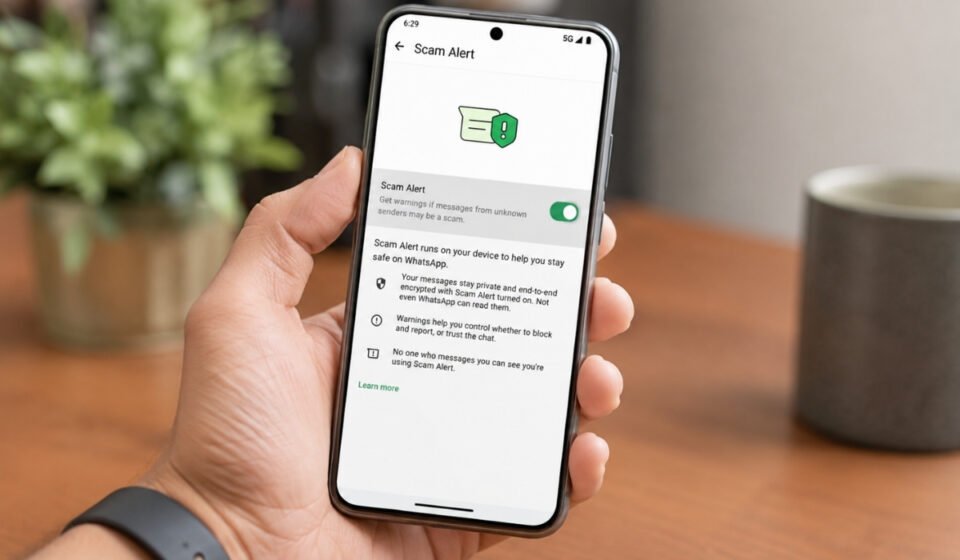

Meta has begun testing a new security feature called “Scam Alert” on WhatsApp, designed to combat fraudulent messages. The limited test is currently rolling out to a select number of Android beta users, with plans to expand availability in the future.
How Scam Alert Works
The feature examines incoming messages from unknown contacts and analyzes patterns commonly associated with scams. If suspicious indicators are detected, WhatsApp displays a warning within the conversation stating that the message “may be a scam.”
This warning is not visible to the sender. Users can then take various actions, such as blocking and reporting the contact or marking the conversation as trustworthy.
The feature also includes a local log that shows users when Scam Alert was activated, which messages were flagged as suspicious, and the version of the AI model used for analysis. This allows users to review the performance of the anti-fraud system.
On-Device Message Analysis
One of the standout aspects of Scam Alert is its reliance on a machine learning model that runs directly on the user’s device to analyze incoming messages. This means message content is not sent to WhatsApp, Meta, or any external server for analysis.
However, WhatsApp does offer users the option to voluntarily share data with Meta’s servers to help improve the system. When a suspicious conversation is marked as trustworthy, users can choose to share the last five messages from that conversation with WhatsApp. Meta states this data will be used to refine the model and reduce misclassification cases.
Limited Rollout to Beta Users
Scam Alert is disabled by default, and users must manually enable it. Its availability is currently very limited, and installing the latest compatible WhatsApp beta for Android does not guarantee access to the feature.
According to circulating information, WhatsApp also plans to launch the feature for iPhone users, but the company has not set an official date for a wider release.
This move comes amid a rise in scam attempts via calls and messages, alongside the evolution of AI tools that give fraudsters greater ability to craft more convincing messages. This has pushed messaging and social platforms to develop new systems to detect and curb these attempts.
WhatsApp has recently introduced several other security features, including support for multiple passkeys and the ability to modify the PIN by adding letters and special characters alongside numbers.